Last Updated: 6-11-2026

Construction site security refers to the integrated system of technology, processes, and personnel used to protect a jobsite's workforce, materials, equipment, and schedule from theft, vandalism, unauthorized access, and operational disruption. Modern construction security goes well beyond fences and cameras — it coordinates access control, video surveillance, workforce identity verification, environmental monitoring, and on-site personnel into a single, unified program.
It matters because the financial stakes are significant. Construction site theft costs the U.S. industry an estimated $1 billion or more annually in equipment and materials losses alone, with total losses including business interruption estimated at $2.5 billion per year. Beyond theft, inadequate security exposes contractors to safety liability (when unqualified individuals enter the site), insurance disputes (when access logs are unavailable), and contract penalties (when owner-required security protocols are not documented).
A comprehensive construction site security program typically includes:
The purpose of construction site security is to maintain real-time visibility, control, and accountability across a constantly changing environment—protecting materials, workers, equipment, and the project schedule itself.
And when all these components come from one unified security vendor, contractors benefit from:
In today’s environment, construction site security isn’t just a set of tools—it’s an integrated strategy best delivered by one partner who provides everything needed to secure the job: software, hardware, personnel, and consulting working together as one system.
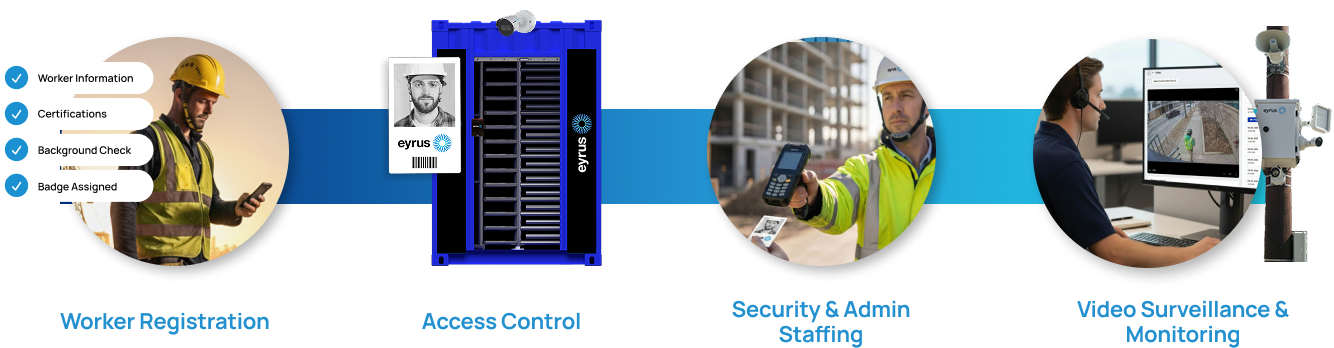
The most effective construction site security programs share a common structural characteristic: all major components — software, hardware, personnel, and consulting — are coordinated through a single operational framework rather than assembled from disconnected vendors.
When these layers are fragmented across multiple providers, gaps emerge. Alert data lives in one system, access logs in another, video in a third, and guard reports on paper. Incident response slows down. Accountability gets diffuse. Costs rise as vendors overlap in capability and duplicate hardware.
When they're unified, the result is a security program that's faster to deploy, easier to manage, and more effective at preventing and responding to incidents.
A unified security platform typically includes:
The software layer is the source of truth. Everything else feeds into it.
Physical security infrastructure includes two broad categories:
Barriers and structures:Turnstiles, vehicle gate arms, guard booths, perimeter fencing, doors, and gates. These establish the physical boundaries that credential systems enforce.
Credential and scanning hardware:Badge printers, Bluetooth trackers, badge and beacon readers, scan kiosks, and handheld scanners for mobile credentialing. These connect physical identity verification to the software layer.
Surveillance hardware:HD cameras (fixed, PTZ, and solar-powered mobile trailers for pre-utility phases), cellular connectivity boxes, floodlights, and loudspeakers for active deterrence. Solar-powered mobile trailers are particularly useful in early construction phases before grid power is available.
Hardware should be selected to match the site's phase, layout, and power availability — and configured to feed into the same platform as access control and workforce data.
Large construction firms lose an estimated 1% of annual revenue to theft — a figure that compounds quickly on multi-year projects. Security personnel combined with integrated technology systems typically reduce that exposure more effectively than either approach alone.
On-site security personnel extend the program's reach into situations technology can't resolve on its own:
Not every site requires all of these roles. Personnel requirements scale with project size, location, owner requirements, and the risk profile of each construction phase.
Security consulting ties the other three components together into a plan that fits the actual site:
Consulting is what prevents a well-resourced security program from being deployed incorrectly. Hardware placed in the wrong locations, credentials that aren't enforced, and cameras that nobody monitors are common failure modes on sites that invested in technology but not in the expertise to configure it.
A fragmented security setup — separate access control vendor, separate camera company, separate guard firm, separate sensor provider — creates coordination overhead that falls on the GC's team. Incidents require pulling data from multiple systems. Vendors blame each other when something fails. Contracts renew on different cycles.
A unified model — where software, hardware, personnel, and consulting share a single operational framework — produces one source of truth, one accountability chain, and one point of contact. For projects that span multiple phases or multiple sites, that consistency compounds significantly over time.
Even while the site sleeps, its systems don’t.
This is when the unified vendor model shines—no juggling CCTV companies, guard firms, and sensor providers. Everything is controlled through one dashboard, with one source of accountability.
Before crews arrive, the system runs through early-morning checks:
Superintendents start the day with one consolidated security report—not five separate emails from five vendors.
This is the busiest window on any construction site.
In a unified system, all movement—people, vehicles, materials—is tracked and tied to one identity layer.
During the workday:
The security vendor’s consulting team may run audits, review access patterns, or update the site’s incident response plan.
Lunch brings a temporary lull, which is ideal for strategic tasks:
Unified systems eliminate gaps—deliveries, workforce, and access all sync automatically.
Afternoons typically carry higher incident risk due to fatigue and accelerated pace:
This prevents the classic “five systems, five conflicting versions of the truth” problem.
Workers begin leaving:
The system confirms the site is fully secured before the night shift takes over.
With the site closed:
All data is funneled into one unified incident log, ready for the next morning’s report.
With one security vendor supplying the software, hardware, personnel, and consulting:
It’s predictable, scalable, and dramatically more secure than fragmented, multi-vendor setups.
Security is increasingly not optional. For a growing share of construction projects, some form of documented, verifiable site security is a legal requirement, an insurance condition, or a contract mandate. Understanding which obligations apply before mobilization — not after an audit or an incident — is one of the most practical reasons to implement a formal security program.
OSHA does not have a single construction site security regulation, but several standards create de facto security obligations:
29 CFR 1926.502(e) — Controlled Access Zones. OSHA requires Controlled Access Zones (CAZs) for certain fall-protection scenarios: leading-edge work, precast concrete erection, and residential construction using alternative fall protection. A CAZ must be physically demarcated and restricted to authorized personnel only. An access control system that enforces zone-level permissions satisfies the documentation and control requirements that OSHA expects — and provides the audit trail needed if OSHA conducts an inspection.
29 CFR 1926.20 — General Safety and Health Provisions. OSHA's general duty requirements obligate employers to prevent foreseeable hazards. Uncontrolled site access — including unauthorized individuals entering active work areas — creates foreseeable hazards. Documented access control provides evidence that the contractor took reasonable steps to prevent unauthorized entry.
Recordkeeping. Access logs create time-stamped records that can be essential in OSHA investigations following a workplace incident. When access control data shows who was on site, where, and when, it accelerates investigation and reduces exposure to citations based on conflicting testimony.
Federal construction projects subject to the Davis-Bacon Act and state prevailing wage laws require detailed, certified payroll records showing hours worked by trade, at verified wage rates. The penalty for inaccurate or incomplete certified payroll records can include project disqualification, back pay liability, and debarment.
An integrated access control and time tracking system solves this problem at the source: every badge scan at the turnstile generates a time-stamped, immutable record of when a worker arrived and departed. That record — tagged to the worker's trade classification — feeds directly into certified payroll reporting without manual reconciliation. A manual timesheet system generates disputes. An automated gate-scan system generates documentation.
Owner requirements for site security have become significantly more prescriptive in recent years, particularly on urban, public, and large commercial projects. Common contract-level requirements include:
Builders risk insurance carriers are increasingly requiring proof of controlled access as a condition of coverage for high-value projects. Requirements vary by carrier and project type, but commonly include:
Contractors who cannot produce access documentation in response to a claim — or who are using manual sign-in sheets that a carrier can dispute — face claims that are delayed, reduced, or denied. An integrated access control system that generates automatic digital logs creates the documentation trail that protects your claim.
.
Construction sites face several categories of risk:
The most effective approach is a layered, integrated strategy — not a single tool:
The critical factor is integration — when these layers share data and feed into a unified incident log, the response is faster and accountability is cleaner.
Access control systems regulate who can enter the site, when, and at which zones — and create a time-stamped, auditable record of every entry and exit event. This does several things simultaneously:
First, it eliminates the "nobody knows who was on site" problem. When an incident occurs, access logs show exactly who entered, when, and through which gate — information that is critical for insurance claims, legal disputes, and OSHA investigations.
Second, it enables zone-level control. Workers can be authorized for specific areas (the electrical room, the crane exclusion zone, the material laydown area) and blocked from others. When someone enters a zone they're not authorized for, the system flags it immediately.
Third, it connects identity to time records. When a badge scan at the turnstile drives a time-and-attendance record, the data can't be manipulated after the fact — which matters for Davis-Bacon certified payroll compliance and for resolving disputes about hours worked.
Yes — with an important distinction based on whether the system is actively monitored or passively recording.
A systematic review published by the Office of Justice Programs found that actively monitored CCTV systems were associated with roughly 15% crime reduction, while passive systems with no monitoring showed no statistically significant effect. When monitoring was combined with active deterrents — audio warnings, strobes, and lighting — crime reductions reached approximately 34%. In other words, a camera that nobody watches is primarily a recording device; a camera backed by a human operator with intervention capability is a genuine deterrent.
For construction sites specifically, strategic camera placement at entry points, material storage areas, laydown zones, and high-value equipment locations provides both deterrence and evidence capture. AI-assisted analytics reduce false alert fatigue by distinguishing between people and incidental motion, so operators are notified only when real perimeter breaches occur.
Not necessarily — it depends on project size, site location, owner requirements, and risk tolerance.
For smaller or lower-risk sites, a well-configured technology stack (access control + monitored cameras + sensors) may provide adequate security without full-time guards. Remote monitoring personnel can watch the site overnight at a fraction of the cost of physical guards.
For larger, urban, or high-value projects, on-site personnel add response capability and administrative capacity that technology cannot replicate. Security guards can physically resolve access issues, respond to incidents, conduct roving checks of blind spots, and handle gate traffic during peak arrival times. Administrative security staff can take over worker registration, credential management, visitor processing, headcount reporting, and timesheet submission — freeing up superintendent time for field supervision.
Some owner contracts and builders risk insurance policies require documented on-site security personnel as a condition of coverage. Check your contract and insurance requirements before deciding.
A construction site security plan should address six core areas:
1. Risk assessment — Identify what's on the site (high-value equipment, copper, tools), where the site sits (urban vs. remote, visibility from public roads), and what phase of construction you're in. Risk profile changes from excavation to steel erection to finishing work.
2. Workforce and identity management — Define credentialing requirements: who gets a badge, what training or certifications are verified before entry, and how visitors and vendors are processed. Establish offboarding procedures so departed workers' credentials are deactivated immediately.
3. Access control strategy — Identify every entry and exit point. Assign access rules by role, zone, and time of day. Determine credential types (badge, mobile, biometric). Plan for temporary access (inspectors, delivery drivers) and emergency access.
4. Surveillance and monitoring — Place cameras at all entry points, laydown areas, storage zones, and blind spots. Define monitoring hours and escalation protocols. Align video retention with your insurance carrier's requirements.
5. Physical security — Fencing, adequate lighting (especially for overnight and off-hours), locked storage containers, and gates. Plan for how physical security changes as the site layout evolves through construction phases.
6. Incident response — Define who gets notified when an alert fires, how the event is documented, and what the escalation path looks like. A single unified incident log that ties access data, video, and alerts together is significantly more useful than separate systems trying to reconstruct an event.
A strong security plan is a living document — review it when project phases change, when significant equipment arrives on site, and after any incident.
The core technology categories for modern construction site security are:
The most effective setups integrate these layers into a single platform so alerts, video, access logs, and workforce data share a common timeline.
Best practices for tool and material security:
Yes — lighting is one of the highest-ROI security investments because it serves multiple functions simultaneously.
Adequate lighting eliminates the shadows and blind spots that give cover to unauthorized activity. Motion-activated lights create a visible signal when someone approaches a secured area off-hours, which can deter casual intrusion. Well-lit sites also improve the quality of camera footage, making video evidence useful for law enforcement and insurance claims rather than too dark to identify individuals.
Approximately 70% of construction site thefts occur at night or on weekends. Lighting directly reduces the window of low-visibility exposure that thieves rely on. For large sites, solar-powered light towers provide coverage in areas without grid power — particularly useful in early construction phases before utilities are connected to the building.
Workforce credentials serve as the identity layer of a construction site security program. When every worker has a unique credential — badge, mobile ID, or biometric — the system can answer the fundamental security question: Is this person supposed to be here, and are they allowed in this area?
Credentialing systems typically verify not just identity but qualifications: OSHA 10/30 training completion, site-specific safety orientation, trade certifications, and background check status. Workers who haven't completed required training or whose credentials have expired are blocked at the gate rather than flagged after the fact.
For subcontractor-heavy sites, credentialing also creates visibility across the full workforce — not just direct employees. Access logs tied to worker identities can show how many workers from which subcontractors were on site at any given time, which is valuable for cost allocation, compliance documentation, and incident investigation.
At minimum, a security plan should be reviewed at each major project phase transition — excavation, foundation, structural, enclosure, MEP rough-in, finishing — because risk profile changes significantly at each stage. A site in structural steel phase has different vulnerabilities than the same site during finishing work.
Beyond phase transitions, update the plan whenever: significant high-value equipment arrives or departs; a security incident occurs; ownership or GC leadership changes; the site layout expands or contracts; or your insurance carrier issues updated requirements. Most experienced security consultants recommend a formal review every 60–90 days on active projects, with informal monitoring and adjustment ongoing.
A construction site security plan is the operational document that ties your technology, personnel, and procedures together into a coordinated program. Without it, even well-resourced security setups develop gaps — cameras pointed at the wrong areas, credentials that aren't enforced, guards who don't know the escalation path.
The checklist below covers the core planning areas every GC should address before mobilization. Treat it as a starting framework, not a final document — your plan should evolve as the project phases change.
☐ Document project type, size, duration, and current phase
☐ Identify high-value assets on site (equipment, copper, tools, materials)
☐ Assess location risk — urban vs. remote, visibility from public roads, proximity to high-crime areas
☐ Review any prior theft, vandalism, or safety incidents on this site or similar projects
☐ Identify which project phases carry the highest exposure (structural steel, MEP rough-in, and finishing work each present different risk profiles)
☐ Define what you're protecting: workers, equipment, materials, schedule, or all four
☐ Identify compliance obligations — owner contract requirements, insurance conditions, OSHA documentation standards, Davis-Bacon certified payroll
☐ Set incident response targets: how fast should an alert be acknowledged? Who gets notified and in what order?
☐ Determine reporting requirements: what does the owner expect, and how often?
☐ Define credentialing requirements — who gets a badge, what training or certifications must be verified before entry
☐ Establish the process for verifying subcontractor workers (not just direct employees)
☐ Set visitor and vendor protocols — how are inspectors, delivery drivers, and unscheduled arrivals handled?
☐ Define offboarding procedures — how quickly are departed workers' credentials deactivated?
☐ Identify who owns credential management on a daily basis (superintendent, PM, or security admin staff)
☐ Map every entry and exit point on the site
☐ Assign access rules by role, zone, and time of day
☐ Determine credential types: badge, mobile, biometric, or a combination
☐ Plan for zone-level control — which areas require elevated permissions (electrical rooms, crane exclusion zones, material storage)?
☐ Define temporary access procedures for inspectors, delivery vendors, and emergency personnel
☐ Identify what happens when someone attempts entry with an expired or unauthorized credential
☐ Place cameras at all entry and exit points, laydown areas, material storage zones, and known blind spots
☐ Determine monitoring approach: passive recording, remote monitoring, or active monitored deterrence
☐ Define alert thresholds and escalation protocols — who gets called when a camera flags an intrusion at 2 AM?
☐ Align video retention periods with your insurance carrier's requirements (commonly 30–90 days)
☐ Plan for power — solar-powered mobile trailers where grid power isn't yet available
☐ Install perimeter fencing with clear signage indicating the site is monitored
☐ Ensure adequate lighting — especially at entry points, storage areas, and blind spots
☐ Lock and secure all storage containers and tool areas at end of day
☐ Plan for how physical security adapts as the site layout changes through construction phases
☐ Identify any areas that will require physical guards in addition to technology
☐ Define response steps for each incident type: theft, trespass, safety event, equipment damage
☐ Assign roles and escalation paths — who is the first call, the second call, the owner notification?
☐ Establish documentation procedures: how is an incident logged, what evidence is captured, and who has access?
☐ Confirm that your access logs, video, and alert data share a unified timeline — reconstructing an event from five separate systems is slow and unreliable
☐ Set owner and insurer notification timelines where contractually required
☐ Schedule a formal security review at each major phase transition
☐ Update the plan when significant equipment arrives or departs, when the site layout changes, or after any incident
☐ Conduct informal monitoring on an ongoing basis — don't wait for a phase transition to address something that isn't working
☐ Train all relevant personnel — superintendents, foremen, and security staff — on current procedures and escalation paths
☐ Confirm that your security vendor's consulting support is active and that the plan reflects current site conditions
A strong construction site security plan isn't a document you file at mobilization and revisit at closeout. Risk profiles shift, site layouts change, and new vulnerabilities emerge at every phase transition. Build the habit of treating it as a living operational document — reviewed often, aligned with daily conditions, and updated whenever something meaningful changes on the project.


